- Home
- SUSTAINABILITY
- Sustainability Management
Sustainability Management
Materiality
Under our corporate mission, BEAUTY INNOVATIONS FOR A BETTER WORLD, Shiseido Group aims for 2030 to achieve our
vision: By connecting with people, we pursue, create, and share new beauty, enriching everyone's lives through
the value of beauty cultivated since our founding.
Along with the formulation of the 2030 Medium-Term Strategy announced in November 2025, we reviewed the material
issues defined in 2019, considering changes in society and the industry, as well as related risks and
opportunities.
Through dialogue with diverse stakeholders—including employees, consumers, business partners, shareholders,
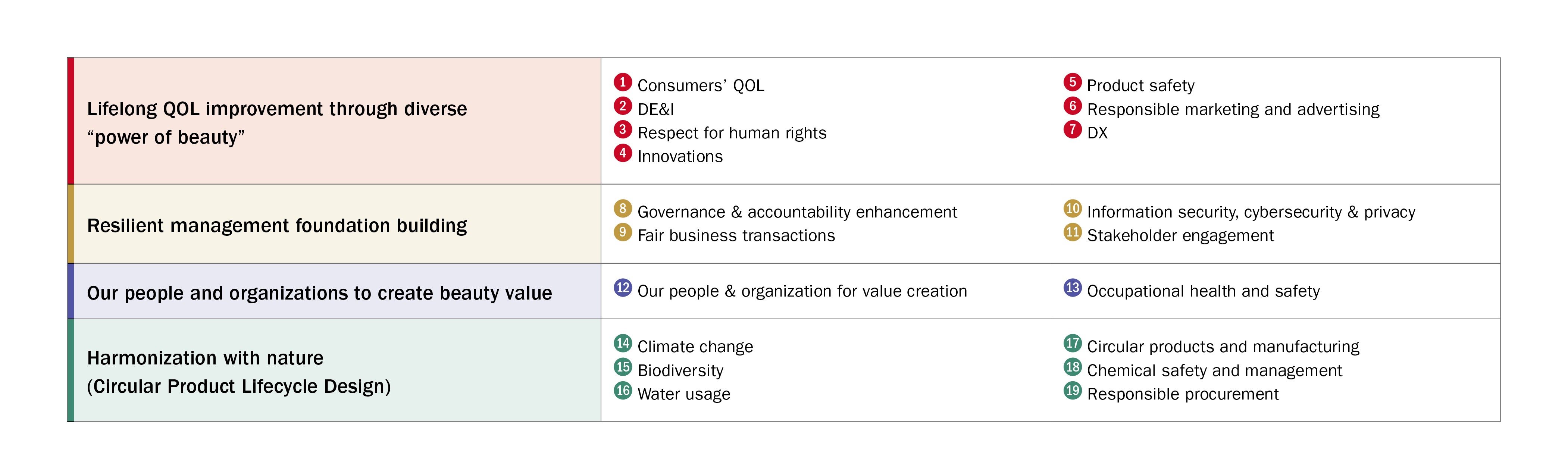
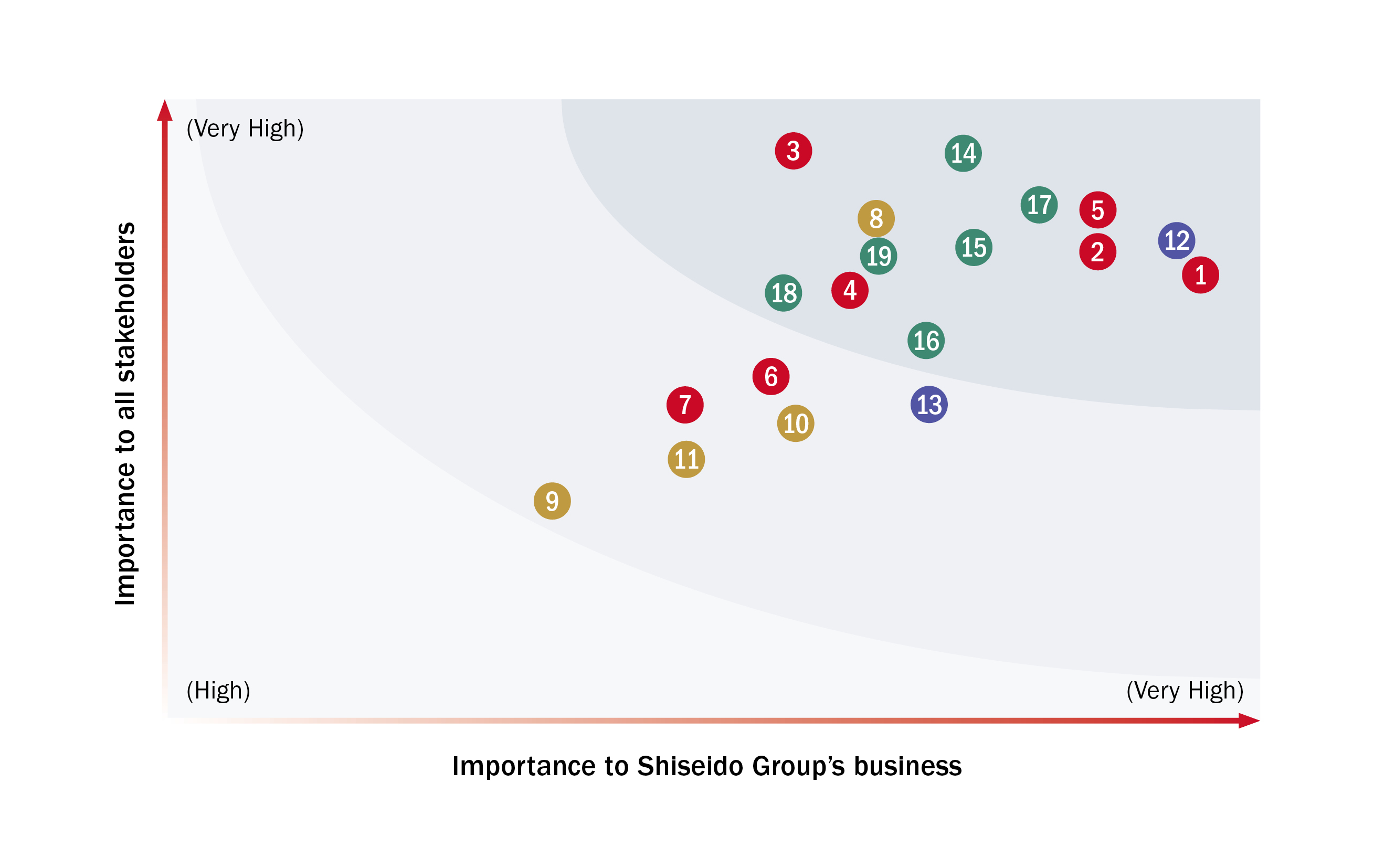
society and the earth—we identified 19 material issues assessed from the two perspectives of "importance to all
stakeholders" and "importance to Shiseido Group's business," and organized them into four categories that led
the 2030 Medium-Term Strategy. These material issues represent key focus areas directly linked to Shiseido
Group's sustainable growth and the enhancement of corporate value. We will address social and environmental
issues through our businesses while pursuing sustained profitability, realizing further value creation through
beauty.
Materiality
Materiality Map
How We Formulated Our Materiality
The following process was implemented to define material issues.
STEP 1 Identification of Social Issues
-
Comprehensive identification of social issues based on international guidelines (GRI, SASB, SDGs, etc.)
STEP 2 Quantitative and Qualitative Surveys and Dialogue with Multiple Stakeholders
-
Quantitative surveys of employees and consumers
-
Interviews and questionnaires with Officers and regional CEOs
-
Interviews with shareholders, investors, and external experts, as well as a review of social expectations and requirements reflected in ESG assessments such as S&P, MSCI, and CDP
STEP 3 Prioritization
-
Evaluating and scoring based on the level of importance to multiple stakeholders and the business
STEP 4 Internal Finalization by Management, Including Corporate Executive Officers
-
Classification and organization of the identified material issues
-
Approval at the global management meeting
STEP 5 Approval by the Board of Directors
Our Approach to Sustainability
To achieve our corporate mission, BEAUTY INNOVATIONS FOR A BETTER WORLD, Shiseido Group has positioned “sustainable value creation” as one of the important strategic pillars in our 2030 Medium-Term Strategy. Within this, in our sustainability strategy, we have set forth strategic actions based on the materiality (material issues) to be addressed in the society and environment areas, while establishing medium-term targets toward 2030 and advancing company-wide initiatives.
In the society area, we are addressing social issues by expanding the diversity, equity, and inclusion (DE&I) expertise we have long cultivated into society through our business and brands. We are executing three strategic actions: “Advancing gender equality,” which aims to realize a society where fair opportunities are available to all—regardless of gender, age, nationality, sexual orientation, gender identity, or disability—and where individuals can live authentically; “Empowering people through the power of beauty,” which seeks to eliminate unconscious biases and prejudices related to beauty, fostering a society that celebrates individual beauty; and “Promoting respect for human rights,” which serves as the foundation of all our activities.
In the environment area, based on the idea of banbutsu shisei, the origin of our company’s name, we are working to develop technologies and build business models aimed at reducing our environmental footprint and contributing to realizing a circular economy. We are executing three strategic actions: “Reducing our environmental footprint” and “Developing sustainable products,” which we work on in collaboration with various stakeholders throughout the entire value chain, and “Promoting sustainable and responsible procurement,” which addresses not only environmental issues but also human rights issues.
Sustainability Governance
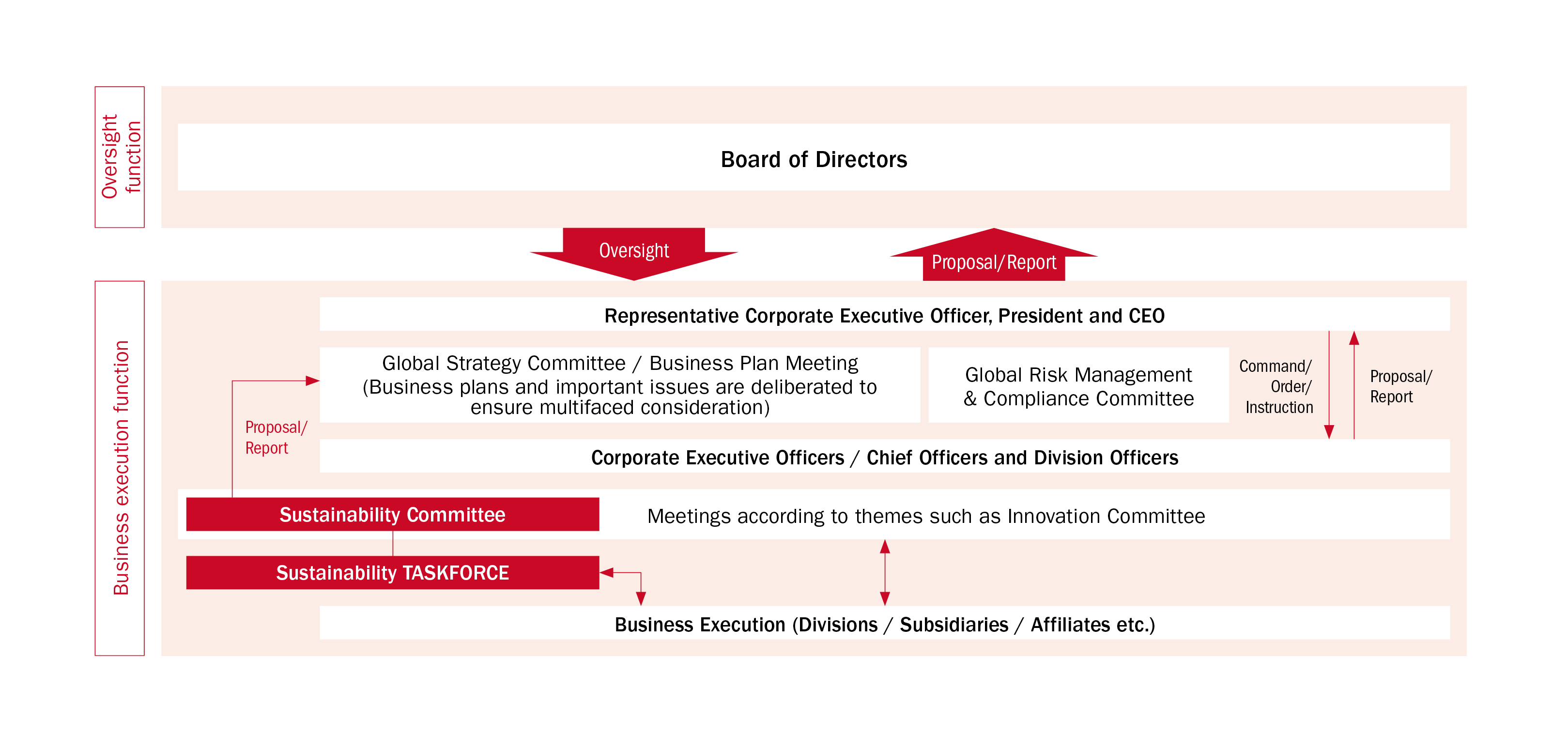
At Shiseido Group, we work to promote sustainability across the entire company through our brands and regional businesses. The Sustainability Committee was set up to ensure timely management decisions related to sustainability efforts and their proper implementation across the Group, and meetings are held regularly. The committee makes decisions on specific action plans, including strategic actions and policies related to sustainability for the entire Shiseido Group, risks and opportunities associated with climate change and the natural environment, and initiatives to address human rights. It also monitors the progress of medium- to long-term targets within our sustainability strategy. The committee consists of the Representative Corporate Executive Officers, and Chief Officers and Division Officers from various fields—including Finance, R&D, Supply Network, Human Resources, Corporate Governance, Corporate Communications, and our brand holders—enabling active discussions on a range of issues from the perspectives of their respective areas of expertise. In addition, important matters related to business execution which require approvals are proposed or reported to the Global Strategy Committee or the Board of Directors. Furthermore, in order to ensure the reliable execution and promotion of strategic actions, a Sustainability TASKFORCE was set up under the Sustainability Committee, consisting of the heads of key relevant functions. The TASKFORCE discusses practical approaches to achieving long-term targets and solving sustainability-related issues, driving activities that involve regional headquarters, overseas offices, and other relevant departments.
Sustainability Promotion Structure
Strategic Actions and Medium-Term Targets
At Shiseido Group, we have identified 19 material issues based on two dimensions: “importance to all stakeholders” and “importance to Shiseido Group’s business”. Based on this materiality, we have set forth three strategic actions and medium-term targets in each of the society and environment areas, and we are promoting initiatives across the entire company. In accordance with our “2030 Medium-Term Strategy,” we have expanded the scope of our actions in the environmental area and updated our targets toward 2030. Furthermore, we have introduced long-term incentive-type remuneration that incorporates ESG-related performance targets, such as CO₂ emissions reduction and the ratio of women in management positions, for leaders in key positions both in Japan and overseas, in addition to the Representative Corporate Executive Officers, Chief Officers, and Division Officers.
Strategic Actions
| Related Materiality | Strategic Actions | |
|---|---|---|
| Society |
|
|
| Environment |
|
|
Medium-Term Targets
| Strategic Actions | Indicators | New Targets toward 2030 Previous Targets (Target year) |
2025 Results | |
|---|---|---|---|---|
| 1. Advancing gender equality | Women's empowerment |
|
50% | Directors 50.0%*1 Officers 46.7%*1 Managers in Japan 43.3%*2 |
| Advancing gender equality |
|
1 million people | Achievement ratio 95%*3 | |
| 2. Empowering people through the power of beauty | Empowering people through the power of beauty*4 |
|
1 million people | Achievement ratio 40%*5 |
| 3. Promoting respect for human rights | Respect for human rights | For detailed activities, please refer to the page of Major Initiatives | ||
- *1:As of April 2026
- *2:As of January 2026
- *3:Direct outreach through the support for girls’ education through Clé de Peau Beauté and Shiseido DE&I Lab, etc.
- *4:Inclusion score will be disclosed in the future
- *5:Direct outreach through Shiseido Life Quality Makeup activities; ANESSA Sunshine Project, etc.
| Strategic Actions | Indicators | New Targets toward 2030 Previous Targets (Target year) |
2025 Results | ||
|---|---|---|---|---|---|
| 1.Reducing our environmental footprint | CO₂ | CO₂ emission reduction (SBTi validation, Scope 1, 2) |
46.2%*1 | 61.7% | |
| CO₂ emission reduction (SBTi validation, Scope 3) |
55%*2 | 47% (Value converted into an absolute amount) |
|||
| Water | Water consumption reduction | 50%*3 | 40% (2026) |
58% (Continued achievement since 2023) |
|
| Waste | Waste to be recycled or recovered for energy | 100%*4 | — | —*16 | |
| Waste to be landfilled directly | — | 0%*5 (2022) |
0% (Continued achievement since 2022) |
||
| 2.Developing sustainable products | Ingredient | Circular ingredient usage | 90%*6 | — | —*16 |
| Eliminating controversial ingredients from formula | 100%*7 | — | —*16 | ||
| Packaging | Recycled or bio-based materials used in cosmetic primary packaging | 15%*8 | — | —*16 | |
| Recycled material used in cosmetic PET packaging | 30% | — | —*16 | ||
| Reduction of virgin petroleum plastic used in cosmetic primary packaging | 20%*9 | — | —*16 | ||
| Switching to sustainable packaging | — | 100%*10 (2025) |
98% | ||
| 3.Promoting sustainable and responsible procurement | Palm oil-derived ingredients | Procurement of sustainable palm oil-derived raw materials | 100%*11 | 100% (2026) |
86% |
| Traceability of palm oil mill | 85% | — | 73% | ||
| Paper | Procurement of sustainable paper | 100%*12 | 100% (2025) |
100% (Continued achievement since 2023) |
|
| Traceability of pulpwood to the state or prefecture level | 100%*13 | — | 80% | ||
| Soy | Procurement of RTRS-certified raw materials or procurement not involving deforestation | 100% | — | —*16 | |
| Mica | Procurement from suppliers not involved in child labor | 100%*14 | — | —*16 | |
| Conflict minerals | Procurement that does not contribute to the financing of conflict or acts of war | 100% | — | —*16 | |
| Supplier management | Critical risks from direct and indirect transactions suppliers | 0*15 | — | —*16 | |
- *1:From all our sites, absolute, compared to 2019. Including our goal of achieving carbon neutrality by 2026 (including carbon offsetting)
- *2:Throughout our value chain, excluding our sites, economic intensity target, compared to 2019
- *3:Economic intensity across all our sites, compared to 2014. New target: production sites, Previous target: all our sites
- *4:Applicable to factory industrial waste. Where both options are available, recycling shall be prioritized
- *5:Excluding waste designated as landfill by law
- *6:Cosmetic ingredient that can be regenerated and recycled within human societal or natural systems, monitored at a raw material level
- *7:Scope: PFAS (as of June 2026)
- *8:Average rate for primary cosmetic packaging
- *9:Per product, compared to 2019
- *10:For plastic primary packaging, on a design basis
- *11:Certified under RSPO’s physical supply chain model, based on identity preserved, segregation, and/or mass balance, palm oil equivalent volume basis
- *12:Including certified paper or recycled paper used in products, measured by paper weight
- *13:For the materials used in the product
- *14:For India and Madagascar, verify RMI membership or conduct individual assessment
- *15:Including secondary and subsequent (upstream) suppliers
- *16:Progress toward the 2030 targets will be disclosed from the 2027 report onward.
Visualizing the Financial Impact of Non-Financial Information
For companies pursuing sustainable growth, visualizing the mutual impacts between business and the environment/society from the perspective of double materiality is essential. Historically, however, the potential damage of CO₂ emissions to social systems, as well as the future risks that rising temperatures and natural disasters pose to business activities, have been treated as external diseconomies and left unreflected in financial statements.
"Visualizing non-financial information"—the process of visualizing the intangible value and impacts of non-financial domains—not only enhances corporate decision-making but also serves as a vital tool for communicating the significance of corporate activities to internal and external stakeholders, thereby boosting employee engagement and motivation. In particular, quantifying the risks and opportunities that climate change and other environmental and social issues present to our operations and finances provides critical insights for assessing business resilience and formulating appropriate management strategies. By converting both the positive impacts created by our products and services and the financial implications of environmental and social factors into monetary value, we can redefine activities previously viewed as mere costs into "investments" that contribute to long-term corporate value. Consequently, this allows us to refine our disclosures to stakeholders.
Since its founding in 1872, the Shiseido Group has consistently operated with the aim of creating value for society. On the environmental front, we have led the industry by driving innovation in technology and social systems, through milestones such as launching refills for compact powder in 1926, introducing sun oil in packaging designed for combustible waste disposal in 1965, completely phasing out CFCs in cosmetics in 1989, and establishing a nationwide recycling system for glass bottles in 2000. In 2019, we expressed our support for the TCFD recommendations. Since then, in addition to analyzing the potential risks and opportunities associated with climate change, we have quantified the financial impact of our business activities. Through continuous discussions between our specialized teams and executive management, we have strived to enhance our business resilience. These insights are compiled annually in our Climate- and Nature-related Financial Disclosure Report.
In the social domain, we are also taking on the challenge of visualizing the financial impacts of physical and psychological benefit. For instance, while suncare product is traditionally designed to prevent sunburn from UV rays, it also protects dermal collagen and prevents dark spots—helping to maintain skin function and a beautiful appearance—while showing potential in preventing skin cancer. Due to changes in the atmospheric and living environments caused by climate change, the amount of UV exposure individuals experience is expected to increase in the future.* As demand for suncare products grows, we are mathematically modeling the long-term positive physical and psychological effects of continuous sunscreen use. Through this dual-directional monetization approach, we are attempting to calculate how much positive impact will be generated by our future business expansion and geographic reach, balanced against the increased environmental footprint from production.
By integrating these quantified financial impacts into our existing management indicators—either as drivers of our corporate value or as currently unpriced negative externalities—we aim to achieve value creation where business growth and sustainability are fully integrated. We will continue to tackle this complex challenge to ensure we fully understand the value of our own activities for better decision-making, and to maintain high transparency and accountability for all our stakeholders, including consumers and investors.
- *Watanabe, S. et al. (2011) Journal of Geophysical Research, 116, D16118
Examples: Positive and Negative Externalities in Non-Financial Domains
| Impact Materiality (Shiseido Group’s impact on society and the environment) |
Financial Materiality (The impact of society and the environment on Shiseido Group) |
|
|---|---|---|
| Positive Externalities | Positive Impact ✓ Shiseido Life Quality (SLQ) Makeup ✓ Long-term skin function maintenance through UV protection ✓ Health maintenance through anti-aging care |
Opportunities ✓ Expanding sales opportunities for refillable products ✓ Expanding sales opportunities for climate-adaptation products ✓ Improving employee capabilities and productivity ✓ Enhancing employee loyalty and motivation ✓ Building trust through long-term relationships with consumers |
| Negative Externalities | Negative Impact ✓ Environmental impact (CO₂ emissions, etc.) ✓ Human rights issues in the supply chain |
Risks ✓ Climate risks (floods, water scarcity, etc.) ✓ Nature risks (decline in pollinators, etc.) ✓ Supply chain risks for resources and raw materials ✓ Policy risks (taxation, regulations, etc.) ✓ Geopolitical risks (conflicts, terrorism, etc.) |
Approval and support for international norms
Approval and support for international norms[PDF:142KB]ABOUT US
-
Who we are
-
History
-
Profile
-
Governance
-
Quality Management
-
Supply Network
-
Region/Business
SUSTAINABILITY
-
Strategy / Management
-
Society
-
Environment
-
Governance
-
Reports / Data
-
Related Information
INNOVATION
-
Research and Development
-
Research Areas
-
Research outcomes
-
Product safety
-
Product Development Policy
-
Initiatives for doctors and researchers
INVESTORS
-
IR Library