


Jan. 7, 2026
Publisher: Shiseido
R&D/Supply Network
Shiseido Develops Technology to Evaluate Subsurface Scattering Light*1 Within Skin “Based on Penetration Depth,” Advancing Skin Transparency Research
Dermal Collagen Density and Epidermal Melanin Levels Identified as Key Factors for Skin Translucency

In pursuit of achieving skin translucency, Shiseido’s optical research is focusing on how light incident on the skin penetrates the stratum corneum, reaches the dermis, and again exits the skin's surface (subsurface scattering light*1), namely, the behavior of light on the skin. The company is advancing research by developing the world's first optical measurement system*2 capable of non-invasively measuring and analyzing three-dimensional facial shape and optical conditions.
This time, through joint research with the Muroran Institute of Technology, Shiseido has further advanced its optical measurement system and developed technology to evaluate the behavior of light at different penetration depths within the skin. Measurement and analysis results revealed that short-wavelength light (blue) reaches the epidermis, mid-wavelength light (green) reaches the area from the epidermis—centered around the basement membrane—to near the upper dermis, and long-wavelength light (red) reaches the collagen layer of the dermis before it is re-emitted from the skin's surface (Figure 1).
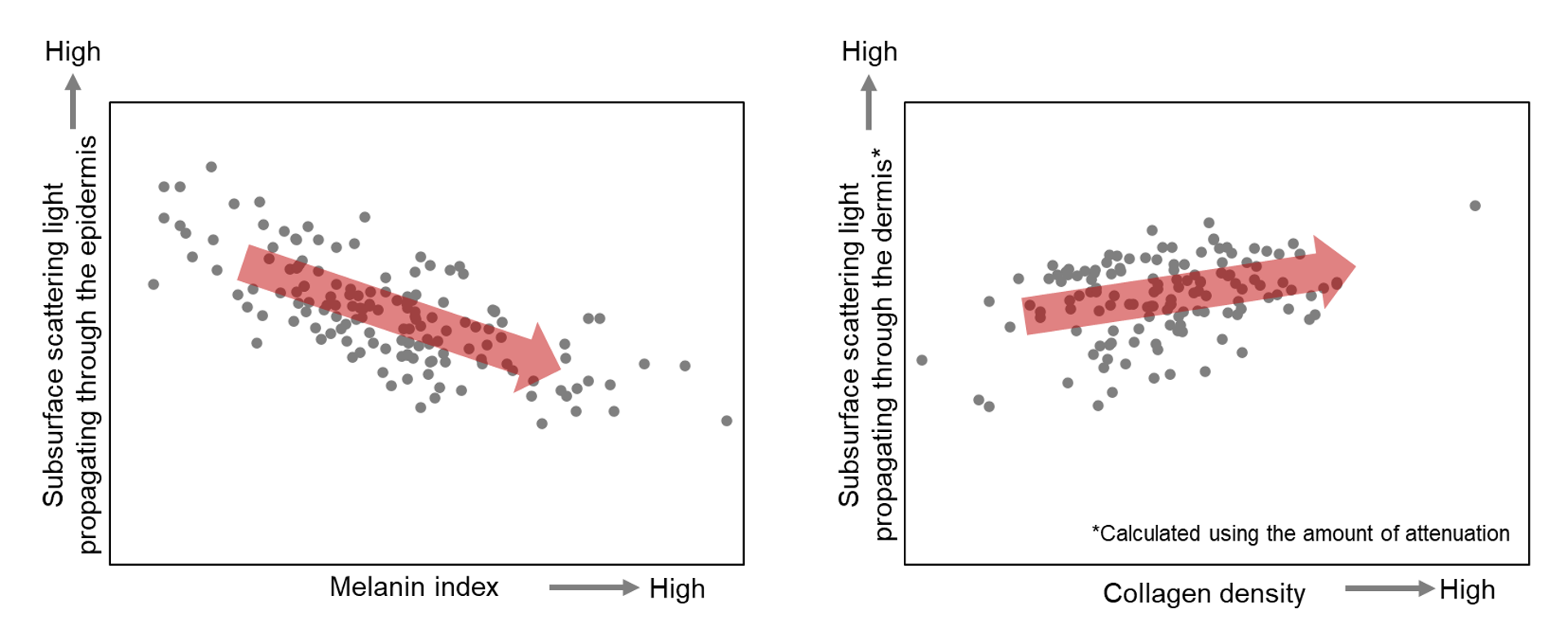
Furthermore, as short-wavelength light (blue) reaches the epidermal layer, non-invasive measurement and analysis of the relationship between melanin level and light reaching and emitted from the epidermal layer revealed that melanin is significantly involved in light absorption. Melanin blocks light, making it difficult to penetrate the skin, thereby reducing the amount of light emitted from the skin's surface. Additionally, as long-wavelength light (red) penetrates the dermal collagen layer, Shiseido applied the internal and external skin elasticity 3D imaging system*3 that visualizes both inside and outside the skin and enables non-invasive observation of collagen status in living human skin, to evaluate collagen fiber density*4 and analyze correlation. The results revealed that reduced collagen density decreases the amount of light reaching the dermis and emitted from the skin's surface (Figure 2).
These findings demonstrate that melanin levels in the stratum corneum and the epidermis, along with dermal collagen density, are essential for achieving skin translucency. Shiseido will continue advancing optical control technologies to realize beautiful skin and will apply these insights to develop new solutions.
Part of the results of this research was published as an academic paper in “Optical Review, 31(2), 261–279” and was also presented at the “European Conference on Biomedical Optics (July 2025)” and “Optics Photonics Japan (December 2025).
*1 Light that penetrates the skin, undergoes absorption and scattering, and is ultimately emitted from the skin’s surface. Also known as subsurface scattering light
*2 Shiseido Develops World’s First Measurement System for Three-Dimensional Shape and Subsurface Scattering Light in Facial Skin (2022)
https://corp.shiseido.com/en/newsimg/3538_o8e53_en.pdf
*3 Patented technology that converts ultrasonic reflected signals from within the skin into elastic modulus, developed through joint research with Honda Electronics Co., Ltd. and Toyohashi University of Technology
*4 Shiseido Wins First Prize for Digital Poster Presentation at the Asian Societies of Cosmetic Scientists Conference 2024 in Goa (2024)
https://corp.shiseido.com/en/newsimg/3818_e8q86_en.pdf
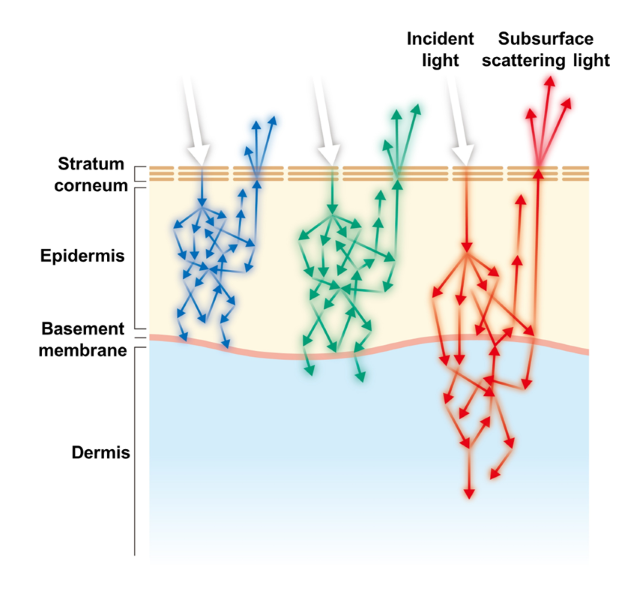
Figure 1 Light penetration depth from within the skin to its surface
Download Small Image[183KB] Download Large Image[636KB]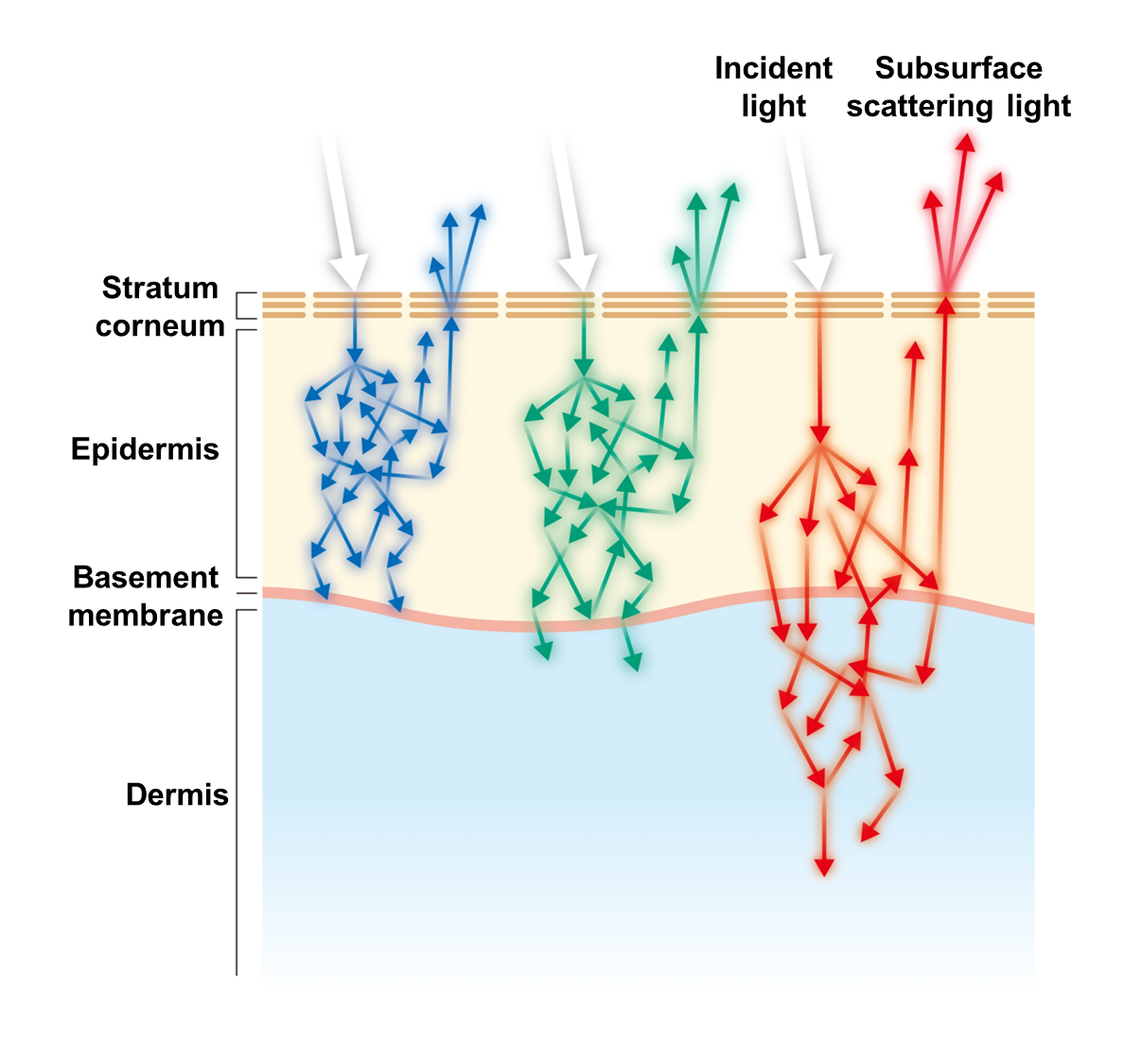
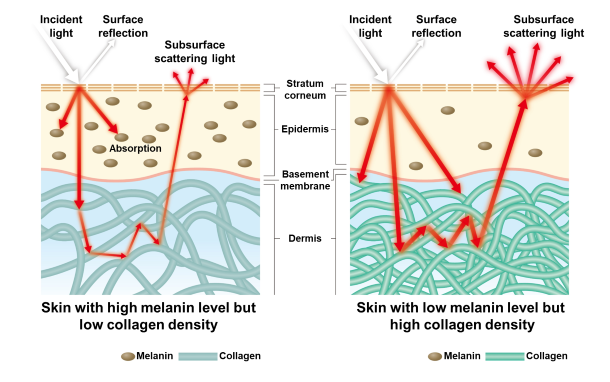
Figure 2 Mechanism by which melanin level and collagen density affect light within the skin
Download Small Image[193KB] Download Large Image[1331KB]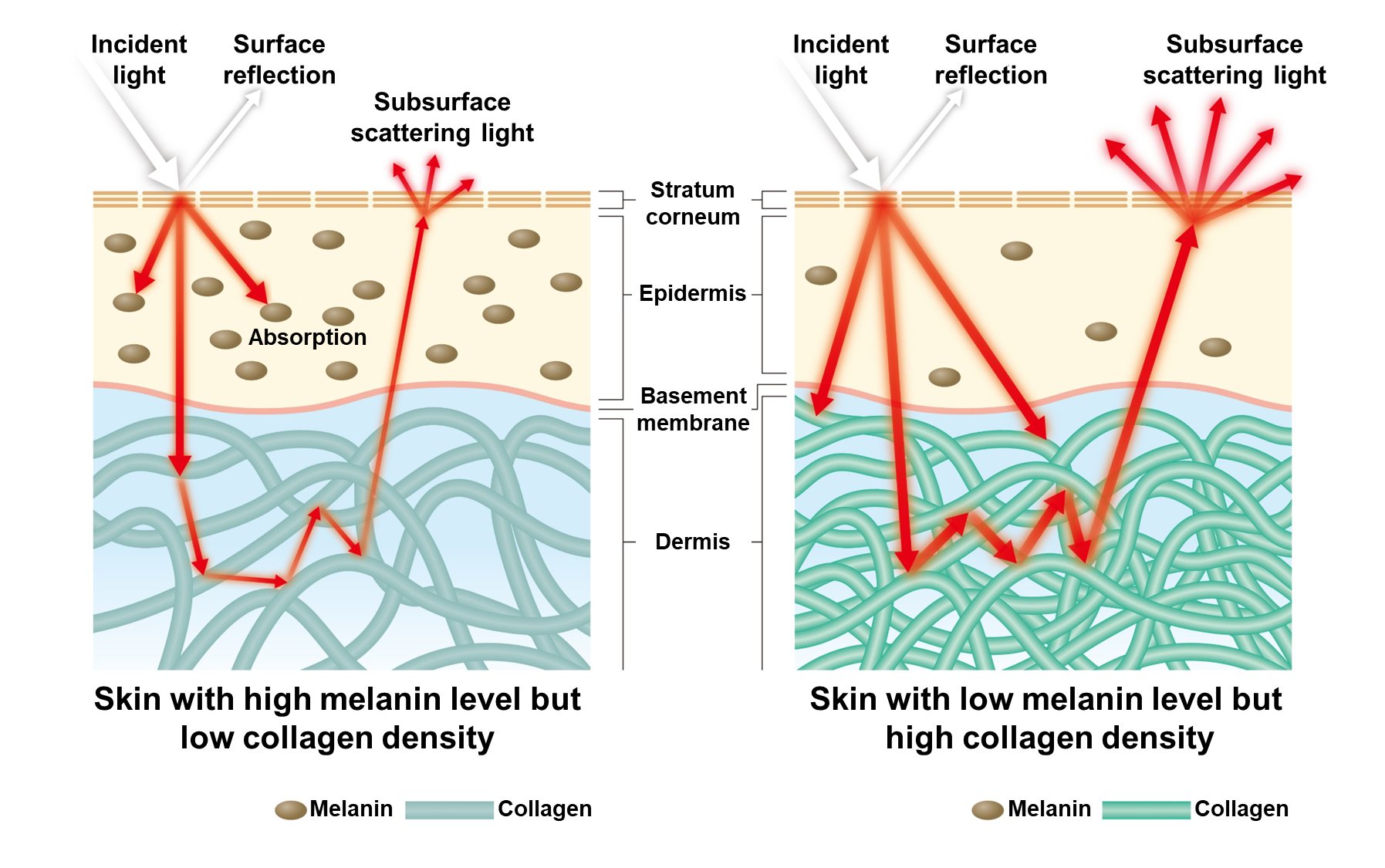
Research Background
In Shiseido’s optical research, early attention was given to the visual “texture” of skin, such as “radiance” and “translucency,” which strongly influences facial impression, and the company’s research was advanced using both optical*5 and psychophysical*6 methods.
Through a joint research project with the Norwegian University of Science and Technology,*2 Shiseido developed a groundbreaking non-invasive optical measurement system that visually and numerically measures and analyzes not only three-dimensional facial shapes but also light emitted from within the skin—a phenomenon that has been difficult to analyze until now. This led to the discovery that the decrease in the amount of light emitted from within the skin is due to age, and that light from within the skin is related to five factors: melanin level, stratum corneum condition, skin moisture level, collagen status, and skin texture.
However, details of how light propagating within the skin reaches specific depths and then exits the skin's surface remain unknown. In this joint research with the Muroran Institute of Technology, Shiseido further advanced analysis technology for its optical measurement system and pursued investigations to elucidate the behavior of light within the skin.
*5 Shiseido Develops Optical Simulation System That Accurately Reproduces Skin Texture (2020)
https://corp.shiseido.com/jp/newsimg/3040_w0w07_jp.pdf (in Japanese)
*6 Shiseido Scientifically Verifies that Facial Skin Radiance Makes a Good Impression (2021)
https://corp.shiseido.com/en/newsimg/3111_y1k16_en.pdf
Analyzing Subsurface Scattering Light by Depth of Penetration to Identify Factors Inhibiting Skin Translucency
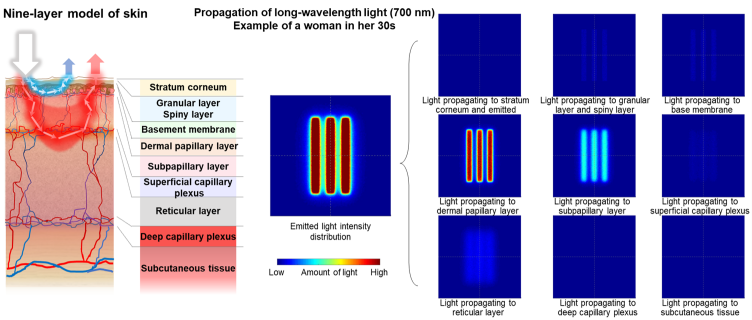
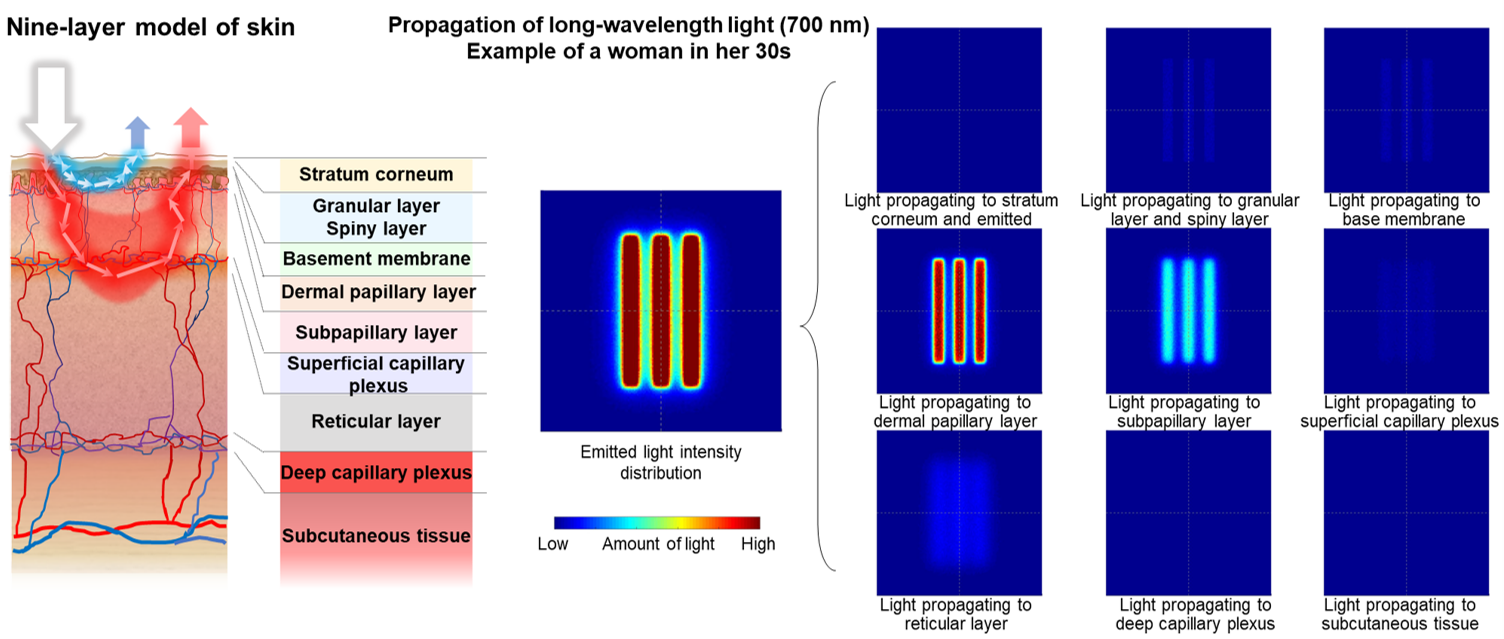
Shiseido and the Muroran Institute of Technology designed a nine-layer mathematical model that explains the actual skin structure and simulates how photons incident on it reach specific layers and re-emerge from the skin's surface. It revealed the physical relationship between light wavelength and penetration depth. This newly demonstrated relationship between light wavelength and penetration depth enables a detailed analysis of which layer the light measured by the system originates from (Figure 3).
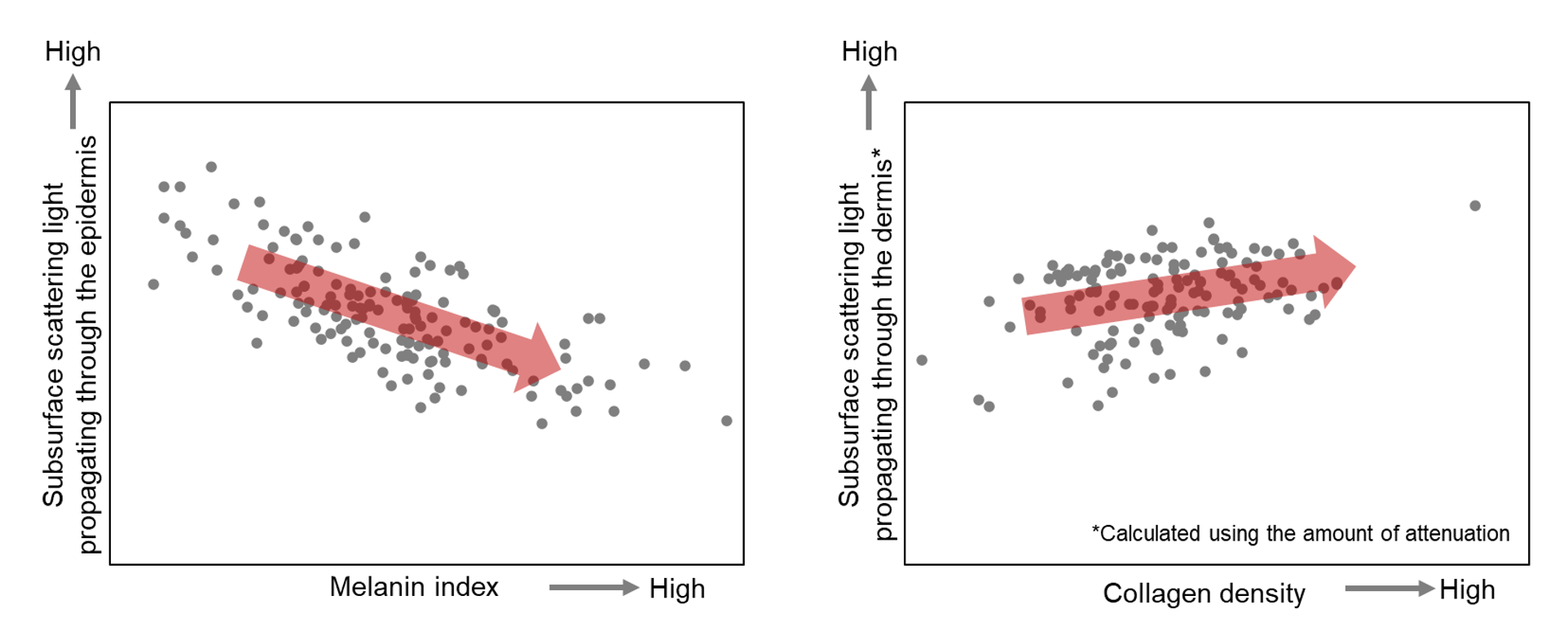
Furthermore, using the optical measurement system, Shiseido applied a newly developed evaluation technique to approximately 150 women aged 20s to 70s, while simultaneously acquiring vast amounts of data through its proprietary non-invasive skin measurement technology. Examination of the parameters influencing light emission at different penetration depths demonstrated that light reaching the epidermis and re-emitted from the skin’s surface is most strongly influenced by absorption by epidermal melanin. Furthermore, light reaching the dermis and re-emitted from the skin’s surface is associated with multiple factors, among which the influence of collagen fiber density is also significant (Figure 4).
*Figure 3 Nine-layer model of skin (left) and propagation characteristics of long-wavelength light (right)
*Figure 4 Relationship between subsurface scattering light propagating mainly in the epidermis and melanin index (left), and relationship between subsurface scattering light propagating mainly in the dermis and collagen density (right)
Relationship Between Subsurface Scattering Light and Aging
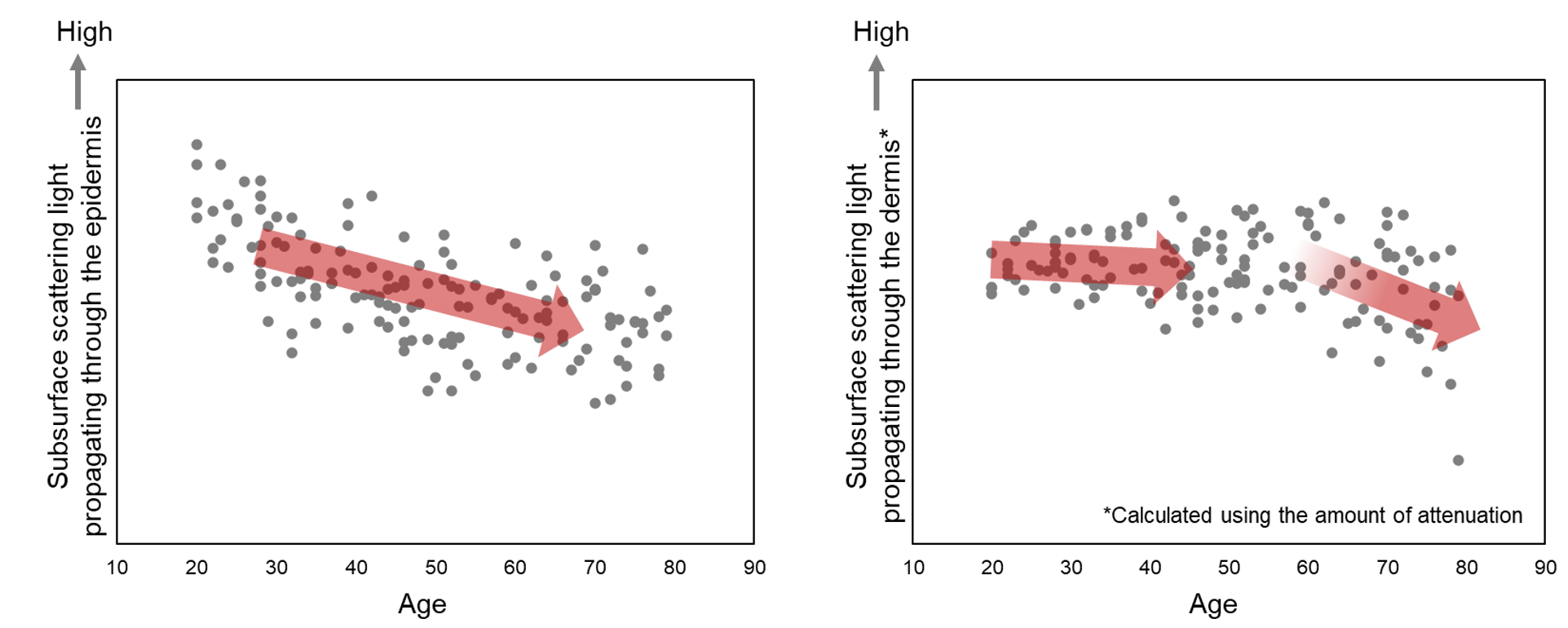
Previous studies have shown that light emitted from within the skin tends to decrease with age, but the characteristics of light at different penetration depths remain unknown. By measuring and analyzing light at different penetration depths, researchers discovered that light reaching the epidermis and re-emitted from the skin’s surface tends to gradually decrease with age. Conversely, light reaching the dermis and re-emitted from the skin’s surface shows relatively small changes in younger age groups, but exhibits a greater tendency to decrease in older age groups (Figure 5).
*Figure 5 Relationship between subsurface scattering light propagating mainly in the epidermis and aging (left), and relationship between subsurface scattering light propagating mainly in the dermis and aging (right)
*The content of the release is correct as of the time of release, but please note that it may in some cases differ from the latest information.
Related News
Jul. 17, 2026
Shiseido Discovers Dual Effect in Cilantro Fruit Extract: Eliminating Senescent Cells and Increasing Normal Cells in Skin

Jul. 16, 2026
Shiseido Announces Recipients of the 19th Shiseido Female Researcher Science Grant
Jul. 6, 2026
Shiseido Discovers “Ring Collagen,” a Collagen Structure That Creates Tension to Maintain Facial Shape