RESEARCH
What Can Be Done Before
the Promotion Review
— Everyday Management
That Nurtures Future
Women Leaders
March 2026 (Japan)


Many companies are actively working to increase the proportion of women in management. Various initiatives are being explored and implemented, from setting numerical targets to offering training programs and strengthening organizational systems.
Yet we continue to hear that progress remains slow and that efforts are not producing the expected results.
Gender should never be a reason to limit any individual’s potential. A healthy organization is one in which people can perform to their fullest regardless of gender. In Japan, however, the reality is that management positions are still predominantly held by men.
At the Shiseido DE&I Lab, we believe the real question should be about the experiences individuals have accumulated, the expectations placed upon them, and the outcomes they have delivered.
In this article, we reexamine the reasons behind the persistent underrepresentation of women in management — looking not only at the moment of promotion review or nomination, but further upstream, at the everyday management processes that precede them.
INDEX
01
“I Belong Here” — And Yet, the Gap Persists
What matters in DE&I is not simply ensuring that diversity exists, but creating conditions in which every individual can fully contribute. When it comes to gender, true inclusion means that people can perform equally, regardless of whether they are men or women.
So, has this been achieved in the workplace?
At the Shiseido DE&I Lab, guided by this perspective, we have conducted analyses using WGI (Work Group Inclusion). (For a detailed explanation of WGI, see the linked article.)
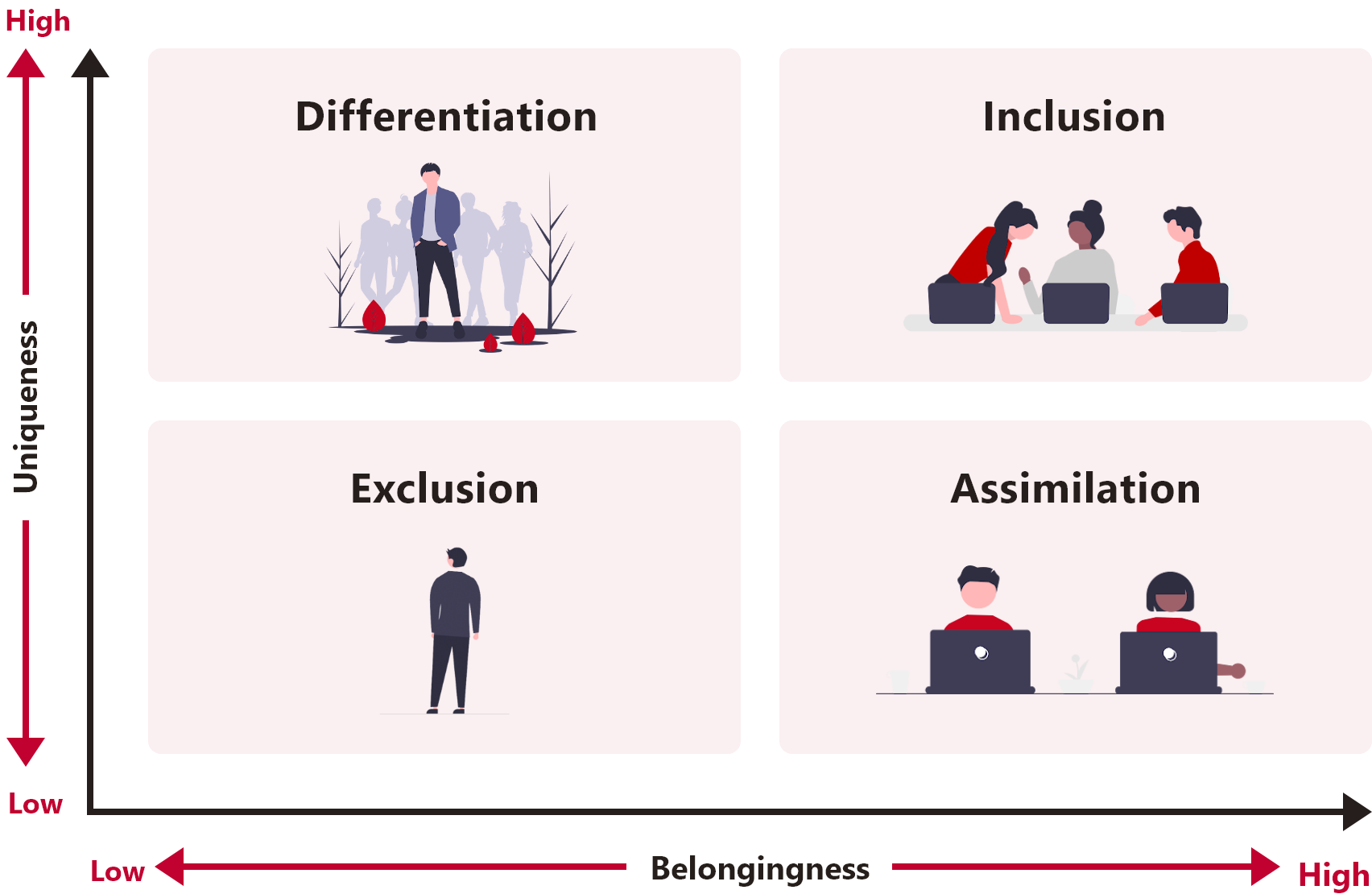
WGI measures organizational inclusion along two dimensions: Belongingness — the sense that “I feel accepted here; I am allowed to be here” — and Uniqueness — the sense that “I am able to express my own perspectives and judgment.”

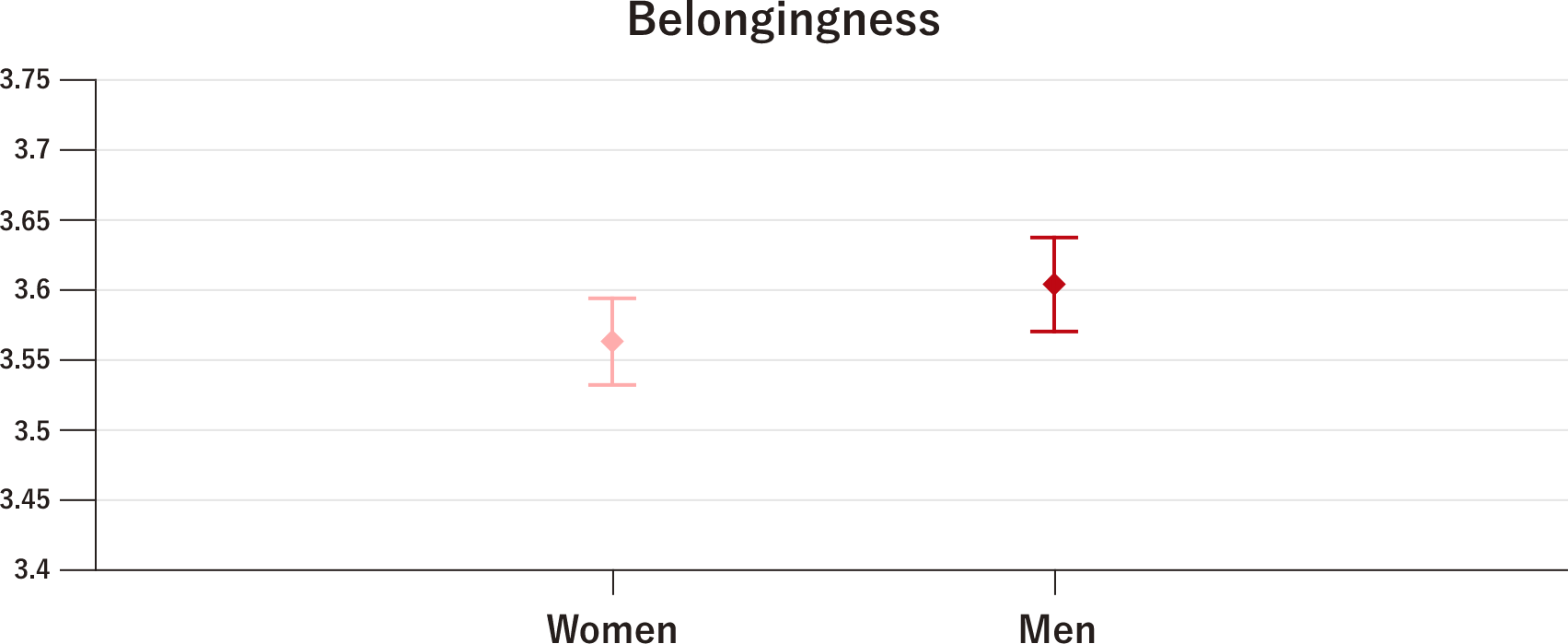
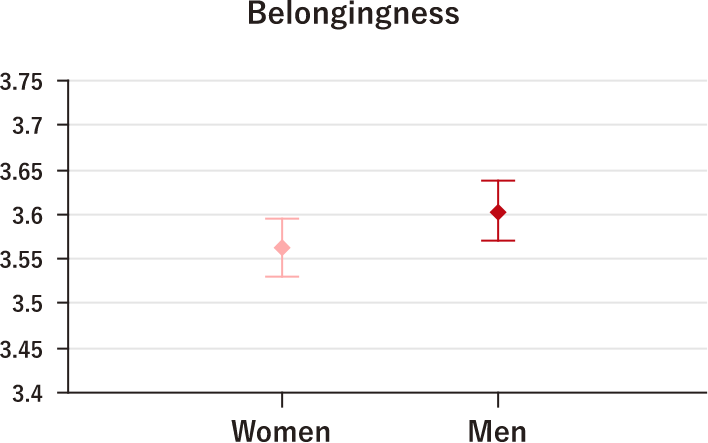
On Belongingness, we found virtually no difference between men and women. There was no significant evidence that women felt excluded or lacked a sense of belonging in the workplace.
This suggests that a feeling of discomfort or exclusion alone may not sufficiently explain the gaps we observe today.
02
The Gap Was in “Uniqueness”
On the other axis — Uniqueness — a gender gap did emerge. Uniqueness refers to the felt sense that “I can offer my own distinct perspective at work” and “I can express differing opinions without hesitation.” It captures an individual’s sense of genuine participation in the organization. Notably, men tended to score higher on this dimension, while women scored lower.
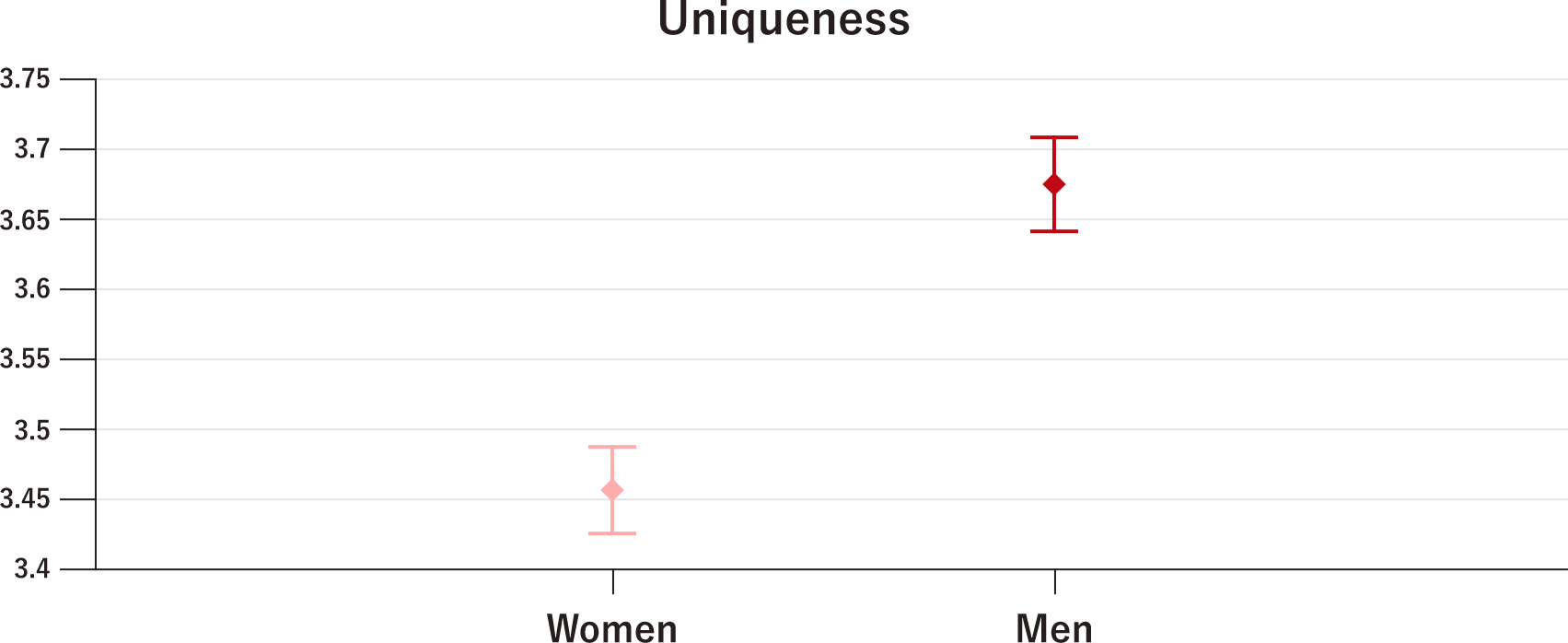

A critical point here is that Uniqueness does not measure ability or aptitude. It reflects a person’s subjective sense of being able to exercise their own viewpoint — not how loud or assertive they are. It might be described as the feeling that one’s own judgments and opinions are expressed within the organization and received meaningfully. Viewed through this lens, it becomes clear that environmental factors — such as whether one is entrusted with responsibility or given opportunities to test their judgment — play a significant role.
Women have a sense of belonging. Yet they do not feel they can fully exercise their own perspectives and judgment. This is a distinct condition — different from exclusion or isolation.
This state, revealed through the two axes of WGI, offers an important insight into why so few women emerge as leaders.
So how is Uniqueness cultivated?
Comparing managers with non-managers, regardless of gender, those in management roles tend to have higher Uniqueness scores. Whether management experience fosters Uniqueness, or whether individuals with high Uniqueness are selected for management — the causal direction is not easily determined. Although identifying the causal relationship is a task for future study, it is highly likely that management experience, as well as the process of being entrusted with expectations as a management candidate, is connected in some way to the development of Uniqueness.
This led us to focus on everyday management leading up to nomination: what kinds of opportunities managers provide to their team members, and what kinds of expectations they communicate. We hypothesized that these factors may contribute to the gap in Uniqueness observed in the development of management candidates.
03
How Do Managers Engage Before the Nomination?
A detailed analysis of engagement survey data revealed that items related to experiential opportunities stood out as key drivers of the Uniqueness gap.
In areas where women in management are particularly scarce, pronounced gender differences were confirmed on three specific points:
- Whether individuals are given opportunities to take on challenges involving risk
- Whether clear expectations for the future are communicated to them
- Whether a concrete career path is visible to them
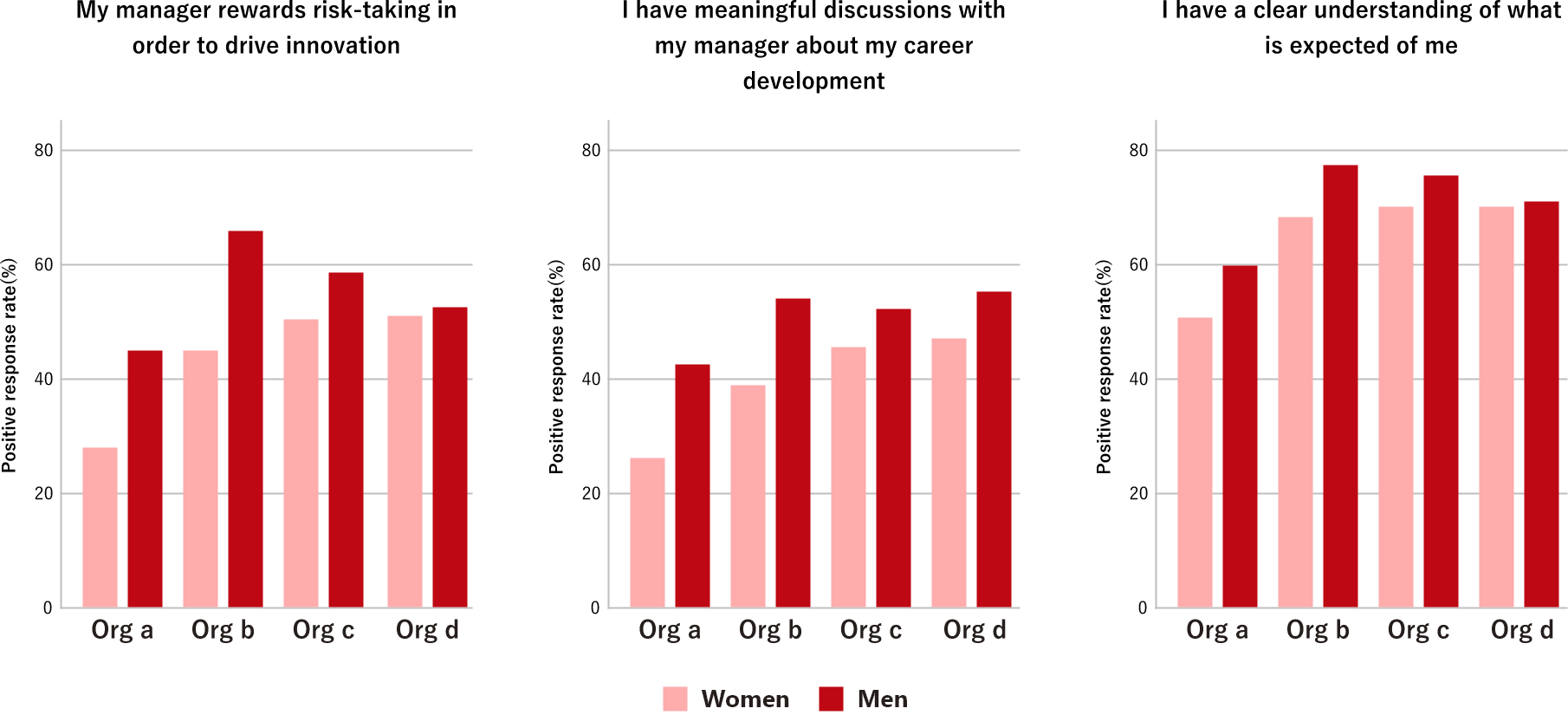
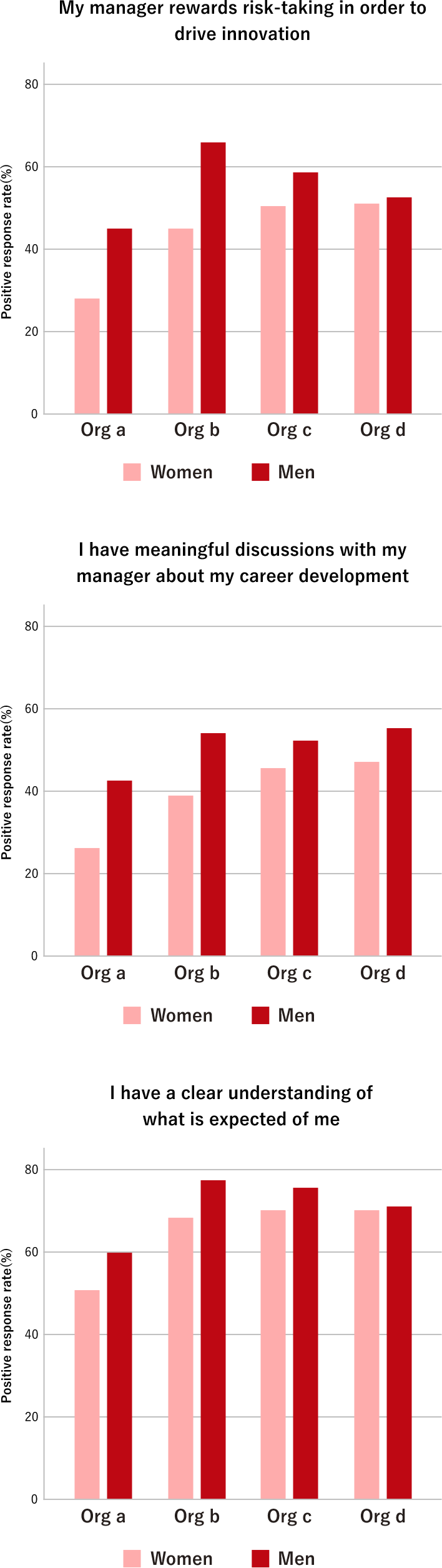
We found that women in organizations where these three scores were low also tended to have lower Uniqueness scores. Challenges that involve risk, expectations for the future, and a visible career path — these experiences serve as the very soil in which individuals test and refine their own judgment and perspective. Uniqueness, it appears, is shaped not only by personal qualities but also by the nature of everyday experiential opportunities.
What, then, makes it harder for women to access these opportunities?
One contributing factor may be “well-intentioned protection” in everyday management.
For example, when assigning a high-difficulty task, a manager might say to a woman on the team, “Are you sure you’re not overextending yourself? Shall we work on this together?” — while telling a man, “I’m counting on you — it’s yours to lead.” In a crisis situation, the manager might step in for a woman, saying, “I’ll handle the explanation,” while telling a man, “Work through it yourself.”
These differences often arise from a place of genuine care and consideration toward women team members.
However, when a manager takes over difficult assignments or crisis responses, the team member loses the opportunity to take on challenges that involve risk. And what was intended as a gesture of consideration — “I don’t want to push her too hard” — may be received as “I’m not expected to do more,” making it harder for the individual to see future expectations or envision a career trajectory.
As these three elements — challenge, expectation, and vision — gradually erode, it becomes increasingly difficult to develop the lived sense of testing and refining one’s own judgment. Over time, the experiential opportunities that cultivate Uniqueness may quietly slip away.
The nomination process for management candidates is presumably conducted fairly. But if there are disparities in what preceded that nomination — the assignments entrusted, the expectations communicated, the quality of dialogue maintained — then it becomes difficult to characterize the outcome as the result of a truly fair selection.
Nomination is merely the final step. The gap may have already formed long before.
The small differences that arise in daily work are, in most cases, not the product of deliberate intent. They accumulate through a manager’s preemptive consideration and unconscious judgments. What matters is not treating people differently based on gender, nor applying a uniform approach to everyone, but rather developing the habit of confirming each individual’s intentions, circumstances, and identity through dialogue before making decisions.
How, then, can we begin to rethink everyday management?
04
What You Can Do in Daily Management
This section offers practical approaches for those in managerial roles to incorporate into everyday management.
Reflect on whether unconscious assumptions are influencing your assignments and communication. “This might be difficult for her because she’s a woman.” “She’s raising children, so I shouldn’t add to her burden.” Such assumptions can creep into decisions without our realizing it. We recommend pausing to check whether gender is serving as the starting point for your judgment.
Draw out the individual’s own intentions before stepping in with consideration. When others preemptively adjust on someone’s behalf, they may inadvertently remove that person’s choices and opportunities for growth. Start with dialogue: “What would you like to do?”
Articulate your expectations clearly. Expectations are not pressure — they are signposts that point the way forward. When you say clearly, “I’d like to entrust this to you,” it becomes easier for the individual to envision their future.
Don’t absorb challenges out of good intentions. Work that involves challenge and risk is a valuable opportunity to cultivate Uniqueness. However, rather than leaving someone entirely on their own, it is important to walk alongside them. The stance of “Give it a try first — if you run into trouble, we’ll think it through together” sustains the courage to take on challenges.
Have regular conversations about career development. Career aspirations and motivation differ from person to person and evolve over time. By building the question “What direction would you like to take going forward?” into routine dialogue, you enable management that centers on individual agency.
The essential principle is this: do not assume.
Choose the best way to engage with each person through dialogue — based on who they are, not on their gender. It is the accumulation of these interactions that leads to future nominations and narrows the opportunity gap.
Showing consideration and setting expectations are not contradictory. In fact, offering opportunities for challenge, entrusting decisions, and supporting growth along the way may be the very essence of inclusive management.
Of course, individual mindset and initiative, as well as the design of systems and structures, are also important factors. In this article, however, we have focused on management — the daily practices that precede all of these and where disparities tend to accumulate quietly over time.
The key insight from this analysis is that the underrepresentation of women in leadership is not solely a matter of what happens at the moment of promotion review or nomination.
Disparities may already be forming at an earlier stage — in everyday management, in how challenges are assigned, in how expectations are communicated, and in the quality of career dialogue.
To ensure fairness in nominations, we must first reexamine what comes before them.
The way we speak to our team members each day, the judgments we make about assignments, and how we express our expectations — each of these small, cumulative acts can nurture each individual’s sense of Uniqueness and help develop the next generation of leaders.
Statistical Analysis Team:
Shintaro Yamaguchi (University of Tokyo), Yoko Okuyama (Uppsala University), Keisuke Tsugumi (Hitotsubashi University), Yuma Oshima (University of Tokyo), Sae Yamamoto (University of Tokyo)