
ACTIONS
Advancing Women's
Empowerment and
DE&I at Shiseido
November 2026 (Japan)

Advancing Women's
Empowerment and
DE&I at Shiseido
"I want to promote women's empowerment, but I don't know where to start."
"We have established formal systems, but the mindset on the front lines hasn't changed, and DE&I progress has stalled."
We frequently hear these concerns from HR professionals and DE&I leaders.
Shiseido, too, has confronted these same questions, through years of continuous systemic and cultural reforms. To demonstrate and share how talent diversity directly connects to corporate growth, we established an in-house research institute, the "Shiseido DE&I Lab."
In this article, we look back on Shiseido’s journey toward advancing DE&I and explore the key challenges we are addressing today.
The Foundation of Women's Empowerment
The history of women's empowerment at Shiseido began long before concepts like "DE&I" or "women’s empowerment" were widely recognized. An iconic milestone in this journey was the creation of "Miss SHISEIDO" in 1934. As the predecessors to today’s Beauty Consultants, this role embodied our commitment to engaging with each customer from a woman’s perspective, sharing a mutual desire for beauty and self-expression. This initiative carved out a pathway for women to find meaning in work, gain expertise, achieve independence, and thrive professionally. This deep-rooted culture of respecting diversity remains the foundational cornerstone of our modern DE&I philosophy.
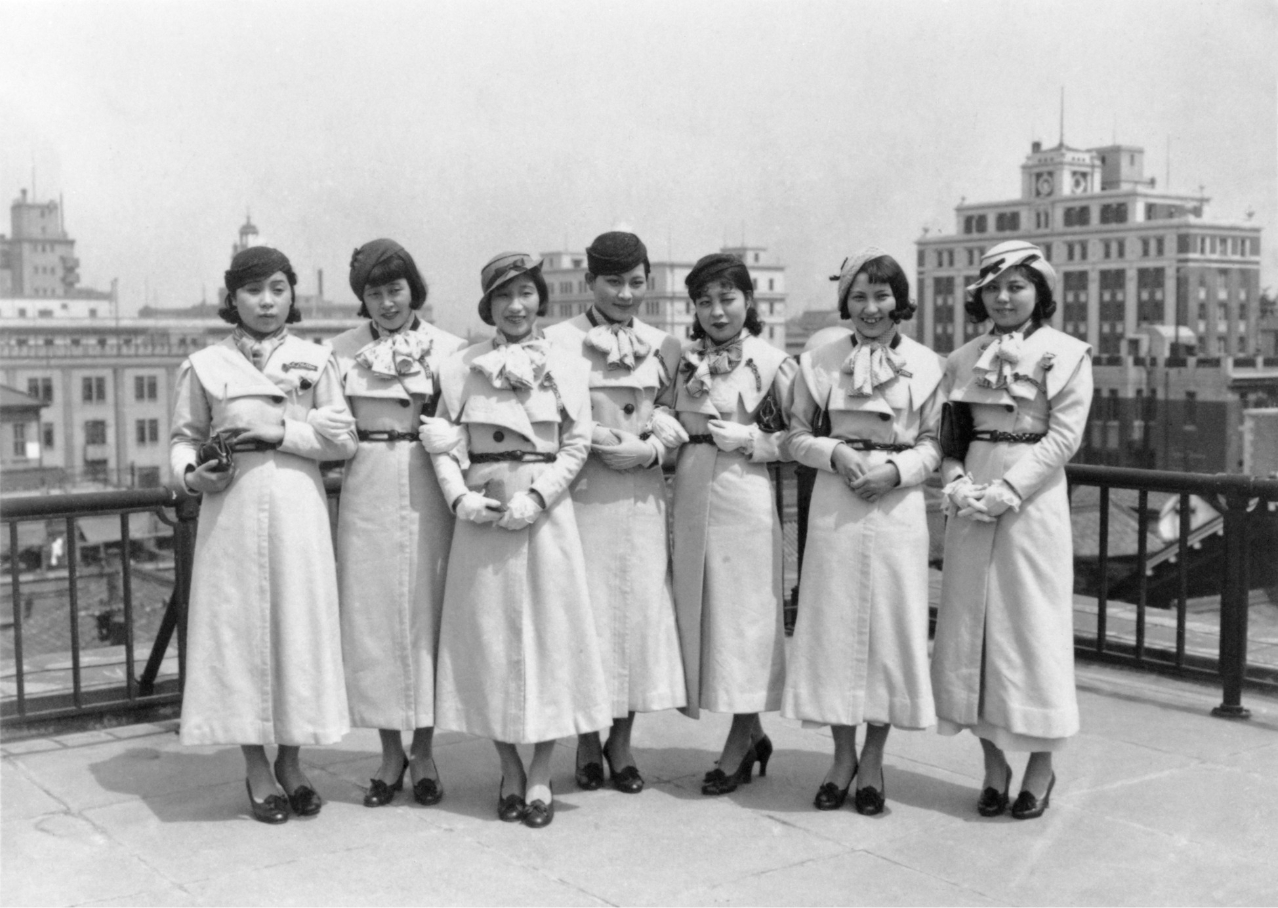
Miss SHISEIDO
Positioning DE&I as a Core Business Strategy — Why We Started with Gender
Shiseido believes that our people are the ultimate source of value creation, and positions diversity, equity and inclusion (DE&I) as an essential pillar of our corporate strategy. Since 2024, our initiatives have focused on four key pillars: Gender, Generation, LGBTQ+, and People with Disabilities.
Among these, gender equality has received our primary focus. We believe that in an organization where women cannot fully thrive, it is difficult to empower a truly diverse workforce or achieve meaningful inclusion. Thus, we positioned gender equality as the vital first step in promoting DE&I.
This article highlights our journey with a specific focus on gender equality.
Elevating the Ratio of Women in Management from 10% to 43.3%
It is often assumed that "women’s empowerment" advanced naturally at Shiseido because of its high female workforce ratio. However, the gender ratio among career-track employees in corporate and sales roles has historically been roughly equal. In 2003, the proportion of women in management across the Shiseido Group in Japan stood at approximately 10%. Although the female employment ratio was high, women remained underrepresented in leadership and decision-making positions.
Through sustained systemic reforms, talent development, and cultural transformation, the percentage of female managers in the Shiseido Group in Japan reached 43.3% in 2026. By 2030, we aim to reach 50% female leadership across all levels in Japan—as a symbolic benchmark of equal opportunity.
The Three Stages of Women's Empowerment
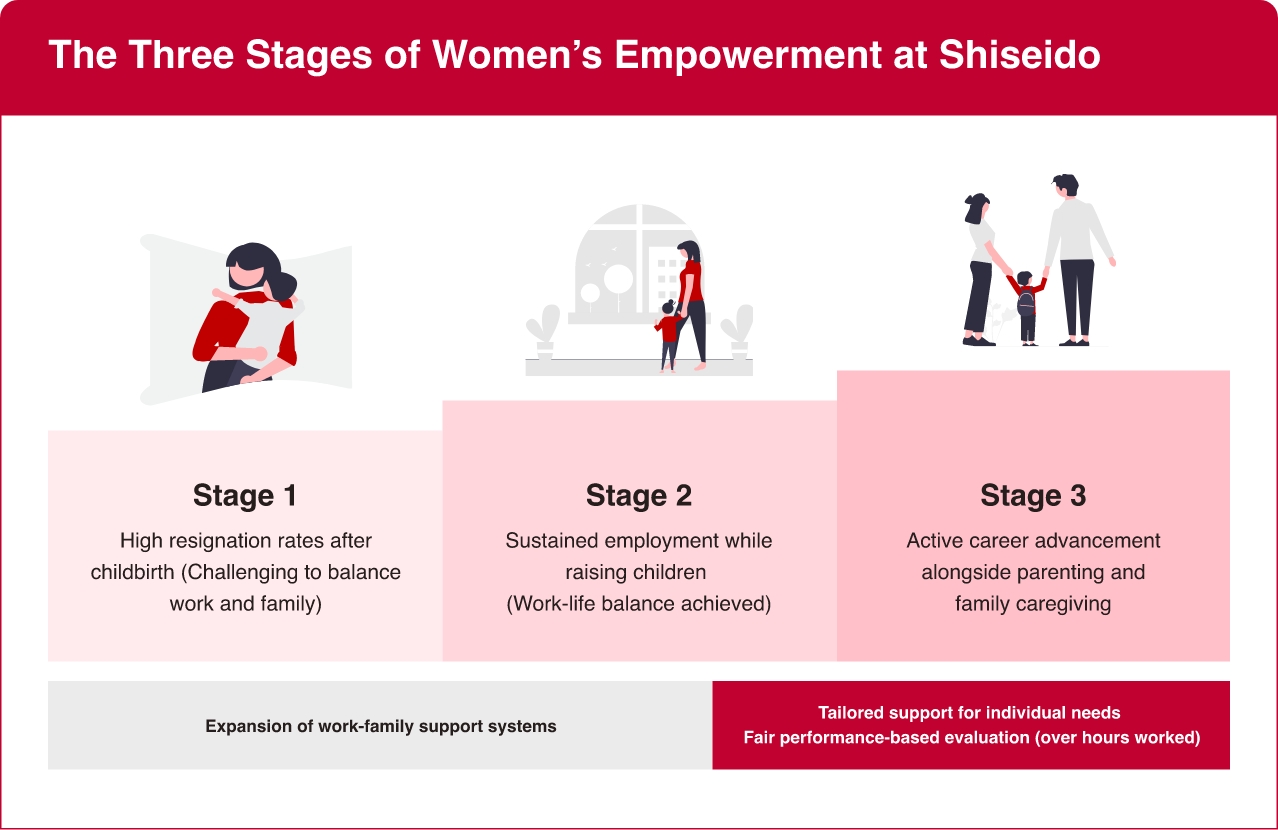
Shiseido's history of women's empowerment can be categorized into three distinct stages.
- Stage 1: A period when female employees frequently left the workforce upon marriage or childbirth due to a lack of institutional support for work-life integration.
- Stage 2: A period when support systems enabled women to remain employed, yet well-intentioned "protection"—driven by unconscious assumptions that demanding roles would be burdensome—inadvertently restricted career development and growth opportunities. Paradoxically, this barrier often becomes more evident as basic support systems mature.
- Stage 3: A stage where employees actively advance their careers and pursue leadership opportunities while navigating life events such as childcare and family caregiving. Shiseido considers itself to be in this phase today.
Many organizations in Japan may currently find themselves navigating Stage 1 or Stage 2.
Shiseido initiated its journey by establishing structural support for work-life balance, introducing childcare leave in 1990—prior to the enactment of Japan's Childcare Leave Act. Over more than three decades, we have continuously evolved toward Stage 3.
*Officially the "Act on Childcare Leave, etc.", currently the "Act on Childcare Leave, Caregiver Leave, and Other Measures for the Welfare of Workers Caring for Children or Other Family Members (commonly known as the Child Care and Family Care Leave Act)."
Systems Alone Cannot Drive Transformation — Shiseido's Two Strategic Pillars
There is no single formula for advancing women’s empowerment; initiatives must be tailored to an organization's specific context.
Shiseido has focused on two primary levers: executive leadership commitment and a comprehensive, holistic framework for career growth.
1. Executive Leadership Commitment: Management consistently communicates not only quantitative targets, but also the fundamental purpose and business rationale behind these efforts.
2. Comprehensive Framework: Continuous, holistic support across four core pillars —
(1) Life Events, (2) Women’s Health, (3) Career Development, and (4) Job Satisfaction & Performance Evaluation—ensures women can maximize their potential over the long term. We shifted our focus to empowering autonomous professional growth, even within time constraints.
Consequently, as of 2025, our post-childcare leave retention rate reached 83.8%, and the average tenure for female employees stood at 14.8 years—virtually equal to that of male employees (14.2 years). These metrics demonstrate that utilizing support programs no longer results in career interruption.
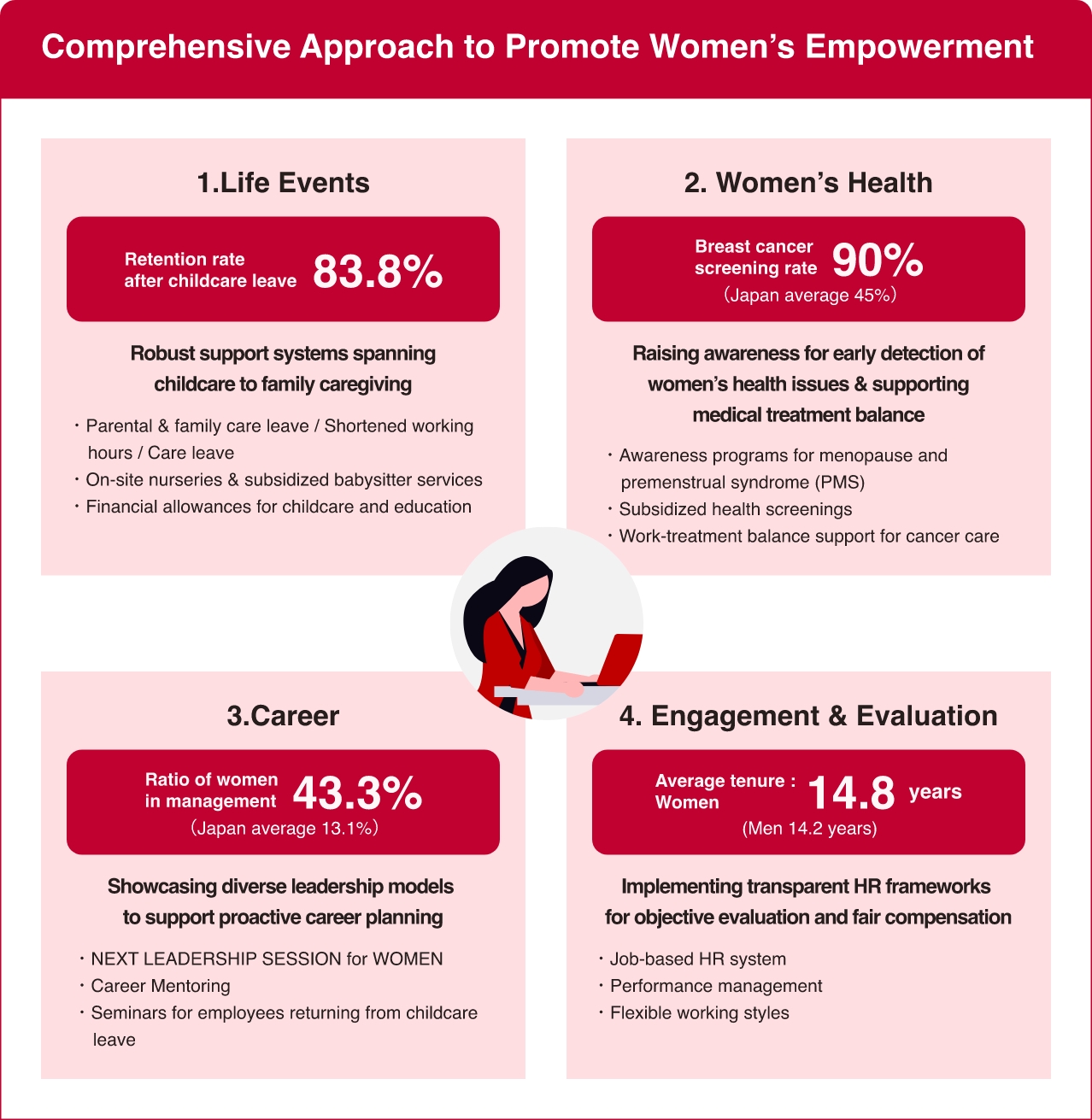
(2025 Shiseido Group in Japan)
Evidence-Based DE&I Promotion
As our initiatives progressed, our focus expanded from addressing gender disparities to reimagining the entire organizational architecture: Who is being granted growth-enabling experiences? Are unconscious biases influencing decisions? These critical questions apply to all talent, beyond gender alone.
Furthermore, these challenges are universal. Systems exist but remain underutilized; training is delivered, yet the pipeline for future leaders remains thin. Does diversity truly drive business growth? To address these industry-wide questions, we recognized the need to assess organizational realities through empirical data rather than intuition. This led to the launch of the "Shiseido DE&I Lab" in 2023.
Serving as an internal testbed, the Shiseido DE&I Lab leverages data to make organizational dynamics visible. In collaboration with university researchers, we conduct empirical studies analyzing the link between DE&I and organizational performance, sharing our learnings publicly.
Our initiatives focus on two main areas.
1. Validating Workplace Assumptions: We apply data analytics to test long-held workplace assumptions, such as "mitigating unconscious bias is critical" or "growth opportunities are unevenly distributed." Grounding these intuitive observations in hard data allows us to prioritize high-impact interventions effectively.
2. Analyzing Best Practices: By identifying high-performing teams characterized by strong inclusion and psychological safety, we analyze the underlying operational behaviors to uncover scalable, actionable insights for other business units.
Our objective extends beyond publishing success stories; we aim to diagnose why initiatives fail, pinpoint the characteristics of thriving organizations, and continually refine our approaches into more effective strategies.
In Closing
DE&I is not a one-time initiative, but a continuous journey. Implementing new policies often uncovers new challenges; however, we view these not as failures, but as valuable indicators for further improvement. Over the past 30 years, Shiseido has continuously refined its systems and addressed emerging workplace complexities. Above all, our overarching goal is to build an environment where every individual, regardless of gender, age, or background, can authentically thrive and contribute their full potential. This vision remains at the heart of Shiseido’s organizational culture.
We invite you to explore our RESEARCH and ACTIONS articles for deeper insights into the specific challenges and case studies outlined here. The Shiseido DE&I Lab will continue to generate and publish actionable research and best practices.
Links
-
How we achieved the transition from Stage 2 to Stage 3
The “Shiseido Shock,” a Work Style Reform for Personal Beauty Partners | ACTIONS | Shiseido DE&I Lab The “Shiseido Shock,” a Work Style Reform for Personal Beauty Partners – 10 Years Later – | ACTIONS | Shiseido DE&I Lab -
Evaluation systems and TIPS supporting "Rewarding Work & Evaluation"
Bridging Diverse Work Styles and Organizational Equity The Potential of Performance Management | RESEARCH | Shiseido DE&I Lab Clarifying Expectations to Drive Teams. Inclusive Management in Practice | RESEARCH | Shiseido DE&I Lab -
Examples of Validating Workplace Assumptions
Bias Edition
Shiseido's Latest Research Examining the Current State and Factors of Gender Inequality | RESEARCH | Shiseido DE&I Lab Evaluation Methods of Gender Bias and Research & Verification Results at Shiseido | RESEARCH | Shiseido DE&I LabInclusion & Leader Development Edition
Measuring Inclusion by Making the Invisible Visible Through Data | RESEARCH | Shiseido DE&I Lab Leadership Development Starts Before Promotion: How “Protective” Behavior Limits Women’s Advancement | RESEARCH | Shiseido DE&I Lab -
Examples of Organizational Practices
Team Management Edition
Learning Inclusion Practices from Shiseido's Case Study | RESEARCH | Shiseido DE&I LabPsychological Safety Edition
Learning Inclusion Practices from Shiseido's Case Study2 | RESEARCH | Shiseido DE&I Lab
